
Worcester, Malvern Hills and Wychavon must find land for 22,457 more homes by 2049. Ten questions on how to plan for them are open until midday on 18 December.
Overview
Worcester City, Malvern Hills District and Wychavon District councils have opened a four-week consultation on a new South Worcestershire Local Plan, which will need to find land for more than 22,000 extra homes by 2049. It asks ten questions, including whether new building should go into Worcester and the existing towns, out across the villages, or into new settlements. Responses close at midday on Friday 18 December 2026 at consult.swlocalplan.org.
Worcester residents are being asked how South Worcestershire should grow over the next two decades, as the three councils that share a Local Plan begin writing a new one only eight months after adopting the last.
The scoping consultation opened on 20 November and is the first formal stage in preparing the plan. It does not name sites. The councils said the location of new homes and the infrastructure to support them “are not covered by the scoping consultation but will be consulted on as the Plan develops”.
Why a new plan so soon
The current South Worcestershire Development Plan Review was adopted in March this year. The councils said changes the Government made to the way housing need is calculated mean work on a replacement must already begin.
The consultation document sets out why. The adopted plan was examined under transitional rules, against the September 2023 version of national policy and the old method of counting housing need. Measured against the new method, it “does not identify sufficient housing land to meet at least 80% of the newly identified requirement”, so the councils are required to start again. The new plan is proposed to run from 2029, when the councils expect to adopt it, to 2049.
The numbers: where 22,457 comes from
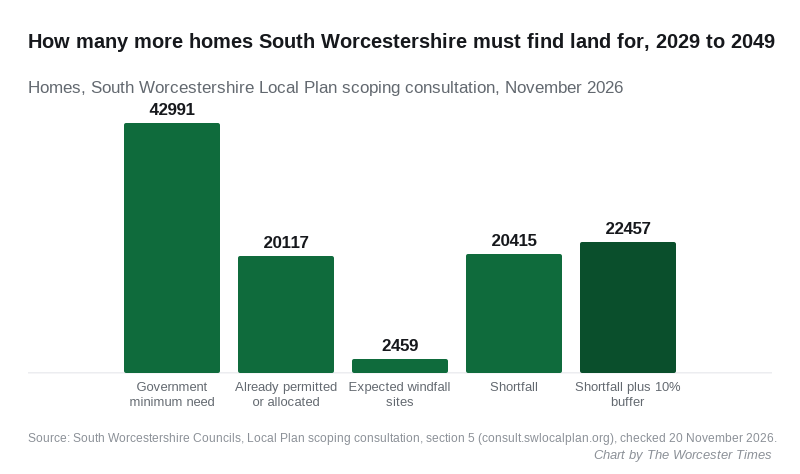
The Government’s standard method gives South Worcestershire a minimum of 2,150 homes a year, or 42,991 over 20 years, according to section 5 of the consultation (checked 20 November 2026).
Some of that is already spoken for. Sites with planning permission, or allocated in the current plan and due to be built between 2029 and 2041, account for 20,117 homes. An allowance for “windfall” sites that come forward without being allocated adds 2,459. That leaves 20,415 homes for which the new plan must find land. The councils say a 10% buffer “should ideally be included” so the plan is found sound, taking the total to 22,457. They add that the figures are likely to “vary slightly” over the three years the plan takes to prepare.
The ten questions
The questions, as set out in the consultation survey, are:
- How the Local Plan should proceed before a wider Spatial Development Strategy is prepared and adopted.
- Any changes or extra ways the councils should consult and engage with people.
- Whether the plan should be a full new plan, a partial review of selected topics, or a single-issue review of housing land only.
- Whether there are reasons to plan for a housing figure other than the Government’s standard method, and if so what.
- Whether there is evidence the plan should take some of the unmet housing need of neighbouring areas.
- Whether the plan should keep its own detailed policies for planning decisions now that national ones have been introduced.
- Whether the revised vision reflects what South Worcestershire should become by 2049.
- Which spatial strategy would best meet the area’s needs.
- What further evidence should be gathered.
- Any other comments.
City, villages or new settlements
Question 8 is the one most likely to shape what gets built near Worcester. The councils say the current plan follows a “rail and sustainable transport” strategy, putting most growth within easy reach of railway stations and public transport. They now ask whether that still works at the higher numbers, or whether one of three broad options would be better:
- Urban concentration: building within or near existing settlements, which could include urban extensions.
- Rural dispersal: spreading development across the area, with many smaller settlements taking some growth.
- A hybrid of the two.
The document adds that the councils may need to explore “one or more new settlements” to accommodate growth to 2049 “in the most sustainable way”.
On neighbouring areas, the consultation notes that the current plan allocated the Mitton site so that 500 of its homes count towards Tewkesbury Borough’s needs. The legal duty to cooperate behind that deal has since been abolished, but councils are still expected to help, so they are asking whether there is evidence for taking on any other area’s need.
Local government reorganisation
Every area in England will need a Strategic or Mayoral Authority by 2028, the councils said, and that will bring a Spatial Development Strategy covering an area larger than South Worcestershire. Because the geography and timing of both are not yet known, the councils are also asking how the Local Plan should proceed in the meantime.
What the councils say
Cllr David Harrison, chair of the South Worcestershire Local Plan Joint Advisory Panel, which oversees the plan’s preparation, said: “There are some big decisions ahead about how South Worcestershire grows over the coming decades and this is your opportunity to help shape them.
“Further consultation will take place once detailed proposals are drawn up, but this is an opportunity for people to get involved at a very early stage before we have that detail and influence the direction we take.”
What it means for you
- To respond: answer any or all of the ten questions at consult.swlocalplan.org before midday on 18 December 2026. You can comment on one question and skip the rest.
- If you own land: the councils’ separate Call for Sites, for land that could be allocated for housing, employment or renewable energy, opened on 19 August and also closes at the end of this consultation on 18 December. It is on the same website.
- What happens next: the consultation site shows responses being summarised from 19 December to the end of March 2027, then analysed and used to prepare the plan from 30 March to September 2027. Specific sites will come later, with their own consultation.
For how the current plan and its housing numbers were adopted in March, and how planning decisions are made in the city, see our Worcester planning page.
Source: Worcester City Council, Malvern Hills District Council and Wychavon District Council.
Have your say